Death’s Heads
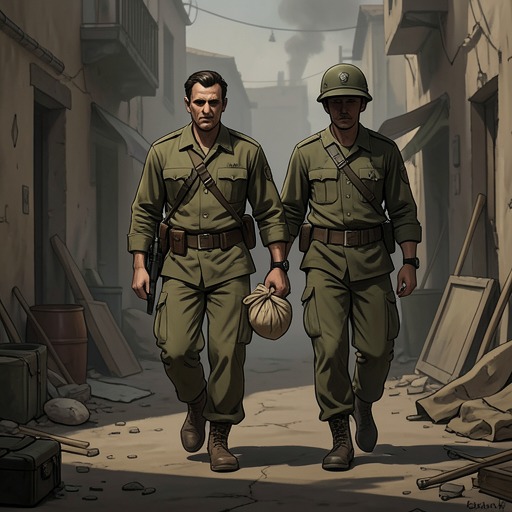
The Most Precious of CargoesThe Death’s Heads are portrayed as perpetrators and custodians of a killing system: they compel prisoners to dispose of the dead, destroy the machinery of murder, and attempt to eliminate witnesses and material traces. As the Reds advance, the force that had terrorized the prisoners retreats or flees west, but its withdrawal does not undo what it has done.
Identity and Position in the Narrative
The narrative also calls the Death’s Heads the Gray-Green. They appear through the perspectives of those who fear them and those forced to serve their purposes, rather than through an account of their own motives or inner lives. The father of the twins works as a barber in Drancy internment camp while French gendarmes guard the prisoners; the text does not identify the Death’s Heads as his direct overseers there. Their role becomes explicit later, in the camp where he is imprisoned and made to work.
The surrounding deportation machinery establishes the scale of the violence without assigning every step to the Death’s Heads. Convoy 49 leaves Bobigny-Gare near Drancy on March 2, 1943, and reaches its destination on March 6. On arrival, qualified doctors select only ten percent of the deportees to be retained; the rest are rejected and disappear. The account presents this selection as part of the larger apparatus of persecution, but does not identify the selectors as Death’s Heads.
Forced Labor and the Handling of Hair
At Drancy, the father’s medical training does not determine his work: because the camp already has many doctors and patients, he becomes a barber after two camp hairdressers leave. The passage places this coerced labor within the same chain of deportation and exploitation, though it does not say the Death’s Heads assign him to the job. He cuts hair while French gendarmes guard the prisoners, drawing on what he learned by watching his father wield scissors.
Later, as a prisoner, he shaves heads day after day and gathers hair in blond, dark, red, and other colors. The hair is bundled into bales, joined to thousands more, and shipped to the land of the conquering generals to be made into wigs, finery, upholstery, or floor cloths. Gray hair is left an unanswered question in the account. The Death’s Heads are not individually named as the organizers of this trade, but the hair’s conversion into useful goods shows how the persecution’s machinery treats the prisoners’ bodies and remains as material to be processed.
Destruction and Retreat
When the trains cease running, the Death’s Heads force prisoners to dig trenches in the snow and burn the great accumulation of corpses around the crematoria. The facilities are hastily destroyed as well. The purpose is made plain: along with the surviving witnesses, the perpetrators seek to eliminate traces of their crimes. The work turns prisoners into instruments of concealment, compelled to destroy evidence of the mass killing while surrounded by its consequences.
The liquidation extends beyond bodies and buildings. Hair that had been prized is no longer collected; packed bales remain unshipped beside mountains of spectacles and heaps of men’s, women’s, and children’s clothes. The effort to make the evidence disappear is therefore shown in the same concrete objects through which the system had reduced its victims to categories and commodities. The heaps persist as an image of what the destruction cannot immediately erase.
As the Reds advance from the east, prisoners hear the distant cannons and hope that the war is nearing its end. The Death’s Heads, meanwhile, make the surviving prisoners continue the burial and burning work. In the forest, the man with the shattered face also watches their retreat: as planes bearing red stars bomb the Gray-Green positions and cannon fire follows, the Hunters of the Heartless go to ground or flee west. The narrative thus shows their power contracting under military pressure, even as the consequences of their crimes remain among the living and the dead.
Narrative Significance
The Death’s Heads embody violence organized as a sequence of tasks: transport, selection, forced labor, disposal, and attempted concealment. The account does not reduce the horror to a single act. It follows the movement from shorn hair made into commodities to corpses burned by fellow prisoners, and finally to the abandoned hair, spectacles, and clothing that accumulate when the killing system begins to break down.
Their retreat marks a change in the balance of power, not a restoration of what was lost. The father survives, but is left with the memory of the moment he threw one twin from the train and the loss of his wife and children. Against that intimate, enduring anguish, the Death’s Heads’ effort to remove witnesses and evidence acquires its full significance: the violence continues to shape survivors’ lives even as its perpetrators lose control of the territory.